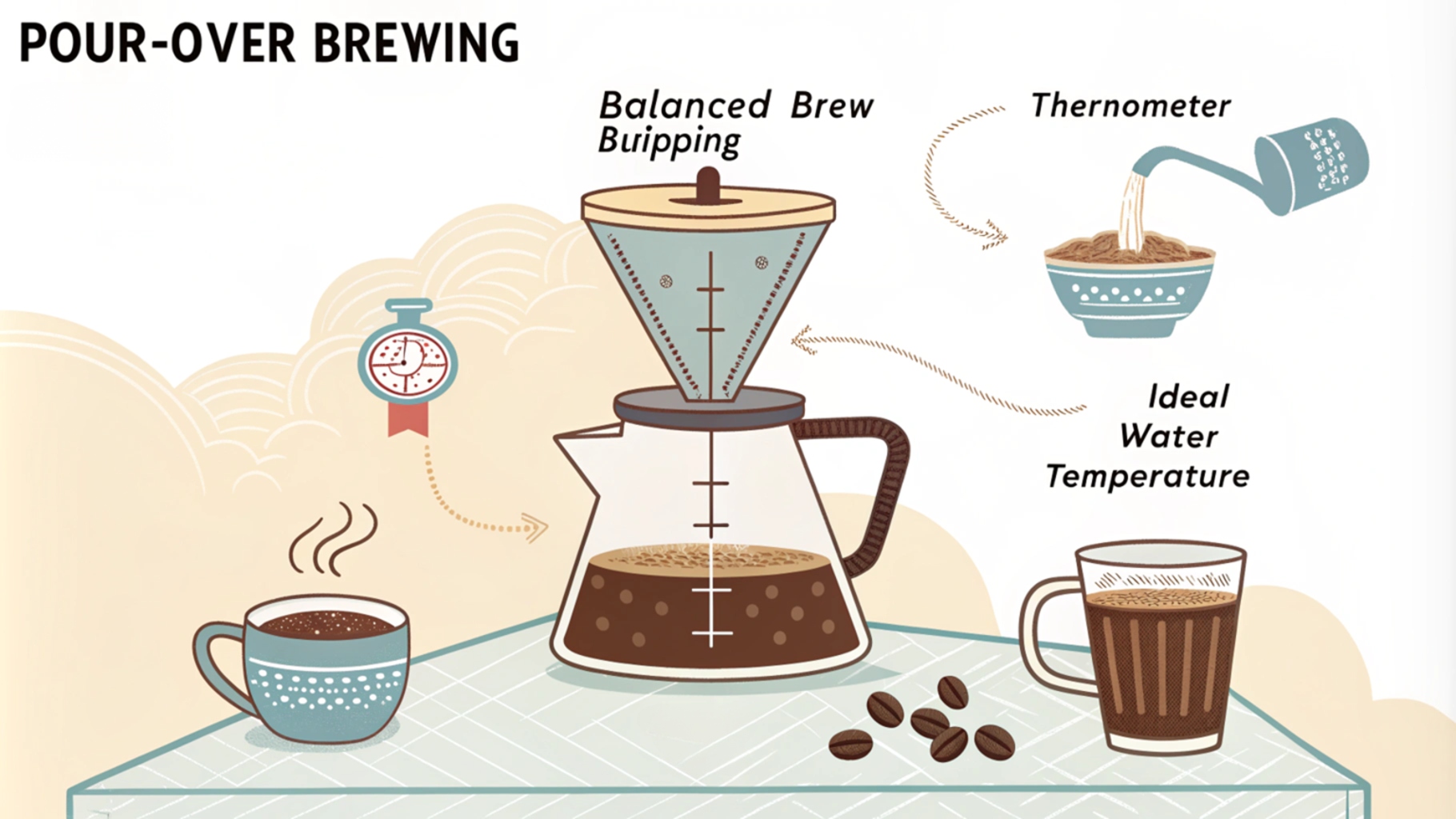
Pour over perfection comes down to four things: a steady ratio, a medium-fine grind, hot (not boiling) water, and slow, even pours. Get those right and you get a clean, sweet, balanced cup. Miss one and the coffee tastes sour or bitter.
This guide gives you a starting recipe, the steps in order, and a fix for each common problem. You don’t need fancy gear. A dripper, a filter, a scale, and a kettle are enough.
What You Need
- Dripper: a V60, Kalita Wave, or similar cone or flat-bottom dripper
- Paper filter: rinse it before brewing
- Kettle: a gooseneck gives the most control, but any kettle works if you pour slowly
- Scale with timer: weighing beats scooping
- Grinder: a burr grinder gives a more even grind than a blade grinder
- Fresh whole beans: medium roasts are a safe place to start
- Mug or carafe
The Balanced Starting Recipe
Use this as a starting point, then adjust to taste.
| Detail | Amount |
| Coffee | 20 g (about 0.7 oz, roughly 3½ tablespoons ground) |
| Water | 320 g (about 11 fl oz) |
| Ratio | 1:16 (1 part coffee to 16 parts water) |
| Water temperature | 195–205°F (90–96°C) |
| Grind | Medium-fine, a bit finer than table salt |
| Total brew time | 2:30 to 3:30 |
| Yield | About 9–10 fl oz of coffee |
You end up with less coffee in the cup than water you pour. The grounds soak up roughly twice their weight in water, so 20 g of coffee holds back about 40 g.
Scale it up by keeping the 1:16 ratio. For two mugs, use 40 g coffee and 640 g water.
Step-by-Step: How to Brew Balanced Pour Over
- Heat the water. Bring it to a boil, then let it sit for 30–60 seconds. This brings it into the 195–205°F range.
- Rinse the filter. Place it in the dripper and pour hot water through it. This removes paper taste and warms the dripper. Dump the rinse water.
- Grind and add the coffee. Grind 20 g just before brewing. Add it to the filter, give the dripper a gentle shake to level the bed, and zero your scale.
- Bloom (0:00 to 0:45). Pour 40 g of water, about twice the coffee weight, and make sure all the grounds are wet. Wait 30–45 seconds. The bubbling is trapped gas escaping. If you skip the bloom, the gas can push water away from the grounds, and the brew extracts unevenly.
- First main pour (0:45 to 1:15). Pour in slow circles from the center outward until the scale reads 150 g. Avoid pouring on the filter walls, because water that slips down the sides skips the coffee.
- Second main pour (1:15 to 1:45). Pour until the scale reads 240 g, using the same slow circles.
- Final pour (1:45 to 2:15). Pour to 320 g, then stop.
- Let it drain. The water should finish dripping through by about 2:30 to 3:30. Remove the dripper, give the coffee a swirl, and drink.
You can also make this recipe in one or two pours. Splitting it into several pours mostly makes the process easier to control.
How Each Variable Changes the Taste
Change one thing at a time so you know what caused the difference.
For deeper background on why these changes work, see our guide to how coffee extraction works.
Troubleshooting: Fix Your Pour Over by Taste
Taste your coffee first, then change the matching variable.
| What you taste | Likely cause | What to try |
| Sour, sharp, thin | Under-extracted | Grind finer, use hotter water, or pour more slowly |
| Bitter, harsh, dry | Over-extracted | Grind coarser, use slightly cooler water, or shorten the brew |
| Weak and watery | Ratio too wide or grind too coarse | Use more coffee (try 1:15) or grind finer |
| Too strong or heavy | Ratio too tight | Add a bit more water or use 1:17 |
| Draws down in under 2 minutes | Grind too coarse | Grind finer |
| Draws down past 4 minutes | Grind too fine or filter clogged | Grind coarser and pour more gently |
| Flat and muddy | Old beans or poor water | Use fresher beans and check your water |
Sour and bitter are the two flavors people confuse most. Sour usually means too little extraction. Bitter usually means too much. The fix goes in opposite directions, so taste carefully before you adjust.
Small Details That Make a Big Difference
Use fresh beans. Coffee loses aroma after roasting. Buy whole beans and grind them right before brewing. Our coffee bean storage tips cover how to keep them fresh.
Match the grind to the method. Pour over needs a medium to medium-fine grind. See our grind size guide to dial it in.
Watch your water. Coffee is mostly water, so water quality changes the taste. Very hard or heavily chlorinated tap water can dull flavor. Filtered water is a simple fix.
Keep your routine consistent. Use the same weights, timing, and pour pattern each time. Consistency makes problems easy to spot.
Frequently Asked Questions
What is the best coffee-to-water ratio for pour over?
A good range is 1:15 to 1:17 by weight. Start at 1:16 (20 g coffee to 320 g water) and adjust to taste.
Do I need a gooseneck kettle?
No. A gooseneck kettle makes slow, precise pouring easier, but you can use a regular kettle if you pour carefully and keep the stream gentle.
How fine should I grind coffee for pour over?
Aim for medium-fine, a bit finer than table salt. If the brew tastes sour or drains too fast, go finer. If it tastes bitter or drains too slowly, go coarser.
Why does my pour over taste sour?
Sour coffee is usually under-extracted. Grind finer, use hotter water, or slow your pours.
How long should a pour over take?
Most cups land between 2:30 and 3:30 total. Use the time as a clue, not a rule. Taste matters more than the clock.
Your Next Brew
Start with 20 g of coffee, 320 g of water, and the steps above. Taste the cup, change one variable, and brew again. A few tries will show you how your beans and your grinder behave, and that is the real route to a balanced pour over.