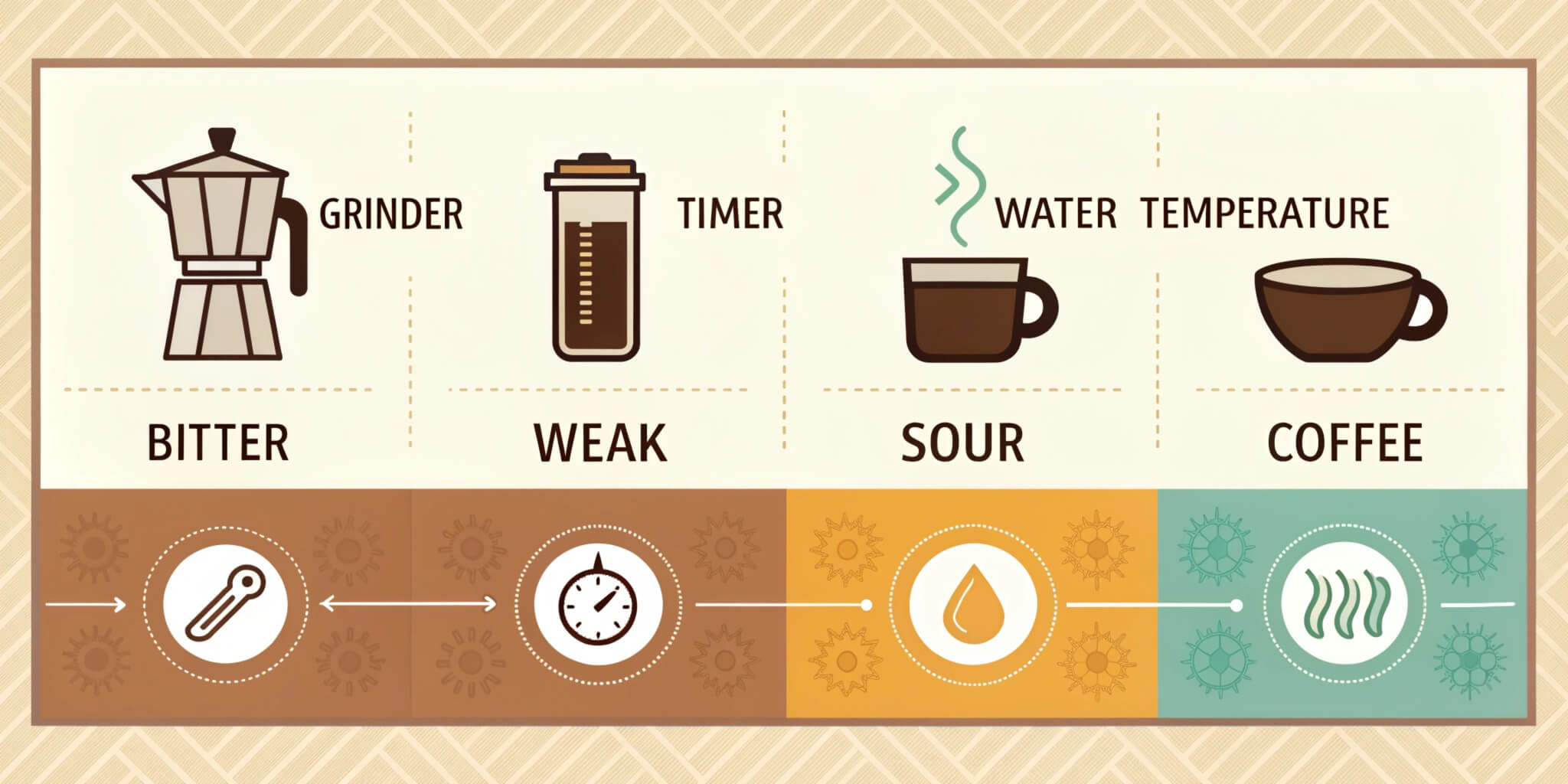
Most bad coffee comes down to one thing: extraction. That is how much flavor the water pulls out of the grounds. Too little gives sour, thin coffee. Too much gives bitter, harsh coffee. The fix is to name the taste, find the likely cause, and change one thing at a time.
This guide helps you with solving common coffee issues at home: sour, bitter, weak, burnt, flat, and muddy cups. You will get a quick diagnosis table, a reliable starting recipe, and fixes in order of what to try first.
Start With the Taste: A Quick Diagnosis Table
Use this table to find your problem fast. Details for each fix follow below.
| What you taste | Likely problem | Try this first |
|---|---|---|
| Sour, sharp, salty, or thin | Under-extracted | Grind finer |
| Bitter, dry, harsh | Over-extracted | Grind coarser |
| Weak or watery | Too little coffee, or under-extracted | Use more coffee |
| Burnt or ashy | Dark roast, dirty gear, or water too hot | Clean gear, lower the temperature |
| Flat, dull, cardboard-like | Stale beans or poor water | Use fresher beans |
| Muddy or gritty | Uneven grind or wrong filter | Use a burr grinder, adjust the filter |
Keep in mind that “sour” and “weak” can feel alike. Sour coffee has a sharp bite. Weak coffee just tastes like tinted water. Sour usually means a grind or time problem. Weak usually means a ratio problem.
Set a Baseline Before You Change Anything
You cannot fix a recipe you never measured. Start with a ratio, then adjust.
A common starting point is 1 part coffee to 16 parts water by weight. Many brewers use anything from 1:15 (stronger) to 1:17 (lighter). Here is what 1:16 looks like:
| Water | Coffee (about) |
|---|---|
| 10 oz (300 g) | 19 g |
| 12 oz (355 g) | 22 g |
| 16 oz (480 g) | 30 g |
| 32 oz (950 g) | 59 g |
A kitchen scale works better than scoops. Scoops vary with bean size and roast. For a deeper walkthrough, see our guide to finding your ideal coffee to water ratio.
Two other baselines help. Use water around 195–205°F (90–96°C), which is the range commonly recommended for drip and pour-over. Use fresh, filtered water if your tap water tastes off.
Fix Sour Coffee
Sour coffee is under-extracted. The water did not stay long enough, or it did not reach enough of the grounds.
Try these in order:
- Grind finer. Smaller particles give up flavor faster.
- Use hotter water. Water that is too cool pulls out acids first and leaves sweetness behind.
- Brew longer. Extend the steep time or slow your pour.
- Check your roast. Very light roasts are naturally brighter and often need finer grinds and hotter water.
Change only one thing per cup. If you change three, you will not know which one worked.
Fix Bitter or Harsh Coffee
Bitter coffee is usually over-extracted. The water pulled out too much, including the harsh compounds that come late.
Try these in order:
- Grind coarser. This is the fastest fix for most home brewers.
- Shorten the brew time. Pull the French press plunger sooner or pour faster.
- Lower the water temperature slightly. Try 195°F if you were using boiling water.
- Use less coffee for the same water, or a lighter roast if you drink very dark coffee.
If the taste is closer to burnt than bitter, read our deeper guide on why coffee tastes burnt.
Fix Weak or Watery Coffee
Weak coffee often has nothing wrong with the extraction. You may simply need more coffee.
Fix Flat, Stale, or Muddy Coffee
These problems come from your beans, your grinder, or your gear rather than your recipe.
Flat or dull coffee. Coffee loses aroma after roasting. Check the roast date, not just the “best by” date. Store beans in an airtight container away from heat and light. Buying smaller bags more often usually beats buying one big bag. Ground coffee goes stale much faster than whole beans, so grinding just before brewing helps.
Muddy or gritty coffee. Blade grinders chop beans into uneven pieces. Fine dust over-extracts and big chunks under-extract, so you get bitter and sour in the same cup. A burr grinder gives a more even grind. See our guide on matching grind size to brewing method for the right setting by brewer.
Off or stale flavors from gear. Coffee oils build up and turn rancid. Rinse and wash your carafe, basket, and grinder parts often, and descale your machine on the schedule the maker recommends.
Match the Grind to Your Brew Method
A grind that works in one brewer fails in another. This is a general starting guide. Adjust it to taste.
| Brew method | Starting grind |
|---|---|
| French press | Coarse |
| Cold brew | Coarse |
| Drip machine | Medium |
| Pour-over | Medium to medium-fine |
| Moka pot | Medium-fine |
| Espresso | Fine |
If your coffee is sour, go one step finer. If it is bitter, go one step coarser. Small moves matter, so change your grinder setting by one notch at a time.
A Simple Troubleshooting Routine
Use this routine when a cup tastes wrong and you do not know why.
- Measure your coffee and water. Use a scale and a 1:16 ratio.
- Check the water temperature and quality.
- Taste and name the problem: sour, bitter, weak, burnt, flat, or muddy.
- Change one variable. Start with grind size.
- Brew again and compare. Repeat until the cup tastes balanced to you.
Taste is personal. A balanced cup for you may be a bit stronger or brighter than someone else’s. Use these tips as a starting point, not a rule.
FAQs
Why does my coffee taste sour even with fresh beans? Sour coffee is usually under-extracted. Grind finer, use hotter water, or brew a little longer. Very light roasts also taste brighter by nature.
Why does my coffee taste bitter? The most common cause is over-extraction from a grind that is too fine or a brew that runs too long. Grind coarser first. Dirty equipment can also add bitter, stale flavors.
Does water really change how coffee tastes? Yes. Coffee is mostly water, so off-tasting or very hard tap water can dull flavor. Try filtered water if your tap water has a strong taste or smell.
How do I make weak coffee stronger without making it bitter? Add more coffee instead of grinding finer or brewing longer. A ratio closer to 1:15 raises strength without pushing extraction too far.