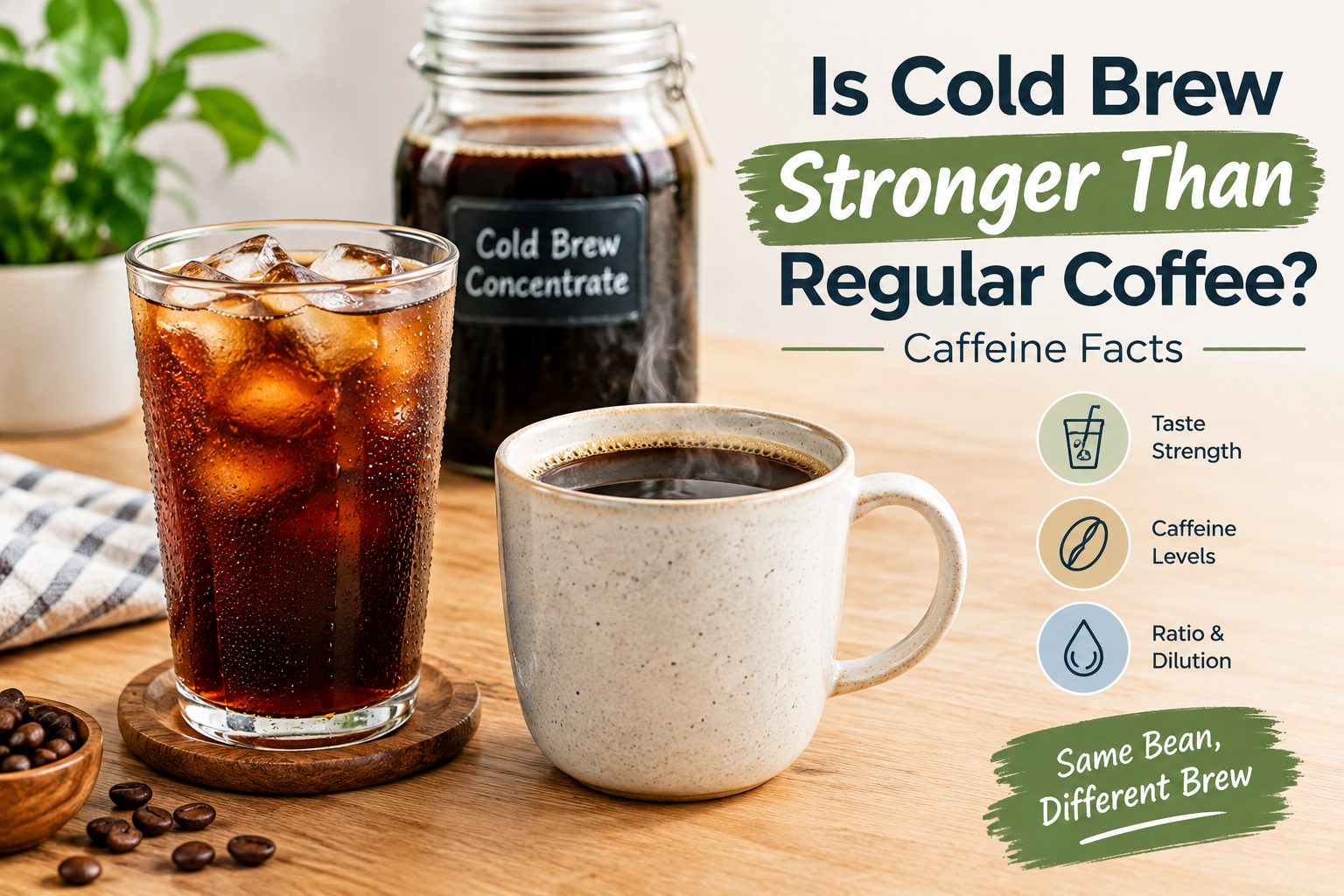
Sometimes. Whether cold brew is stronger depends on what you mean by “strong” and on how the drink was made. Cold brew often tastes smoother and less bitter, so it can seem milder. But because it’s usually made with more coffee per cup of water, a glass of cold brew can contain as much caffeine as hot coffee, or more.
There is no single fixed answer. This guide breaks down taste strength, caffeine, and what controls both, so you can predict (and adjust) the strength of your own cup.
Three Meanings of “Strong”
People use “strong” to mean different things. Separating them clears up most of the confusion.
| What “strong” means | Is cold brew usually stronger? |
|---|---|
| Bold or bitter taste | Usually no. Cold brew tends to taste smoother and less sharp. |
| Concentrated (lots of coffee per water) | Often yes, especially concentrate or recipes with a high coffee ratio. |
| More caffeine in your cup | It depends on the ratio, steep time, and cup size. |
A cold brew can taste mellow and still be high in caffeine. Smoothness is about flavor, not caffeine level.
Why Cold Brew Can Seem Stronger
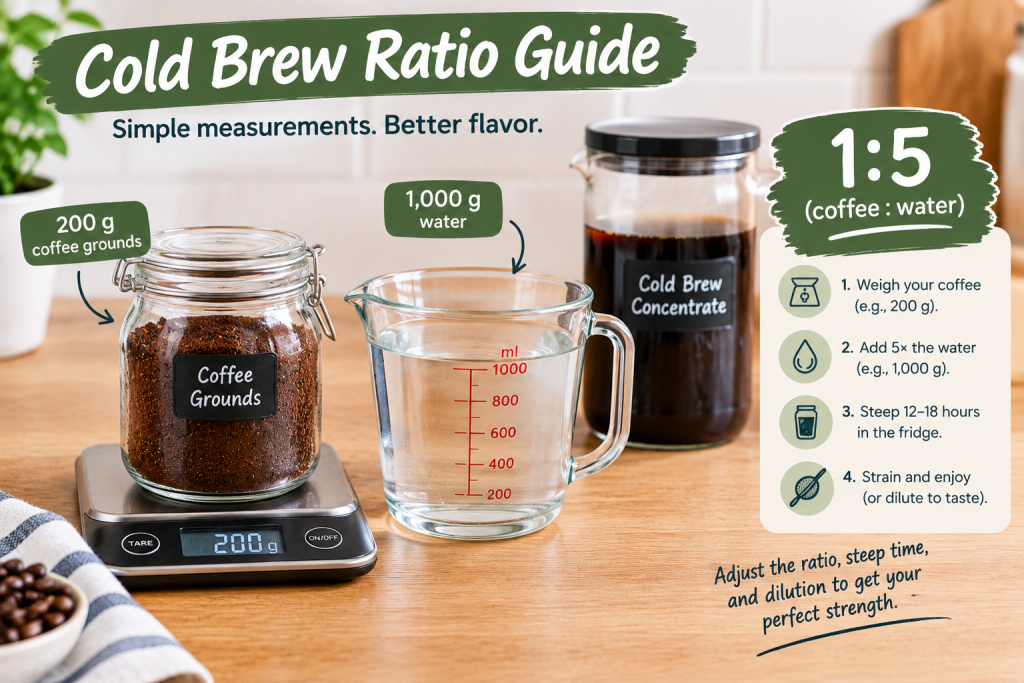
Cold brew recipes usually use more coffee for the same amount of water. Here is a rough comparison by weight of coffee to water:
These are common starting points, not rules. Brands and home recipes vary a lot.
More coffee in the water means a more concentrated liquid. If you drink cold brew at that concentration, you’re taking in more dissolved coffee, including caffeine, per ounce than you would from a typical hot cup.
Why Cold Brew Can Seem Weaker
Several things pull the other way:
So a diluted, iced cold brew can easily be weaker than a hot cup, even though the concentrate it came from was strong.
Caffeine: Cold Brew vs. Regular Coffee
A commonly cited estimate for hot brewed coffee is about 95 mg of caffeine per 8 oz (240 ml) cup. This is an average. Real amounts vary by bean, roast, brew method, and cup size.
Cold brew has no single standard number. Studies and brand labels show wide ranges, because recipes differ so much. In practice:
If caffeine matters to you, check the label on bottled cold brew, or ask the coffee shop for the caffeine content of a given size. For homemade batches, only a lab test would give an exact number. You can treat your recipe’s ratio and serving size as a rough guide.
What Controls Cold Brew Strength
If you make cold brew at home, you control the strength. These variables matter most:
- Coffee-to-water ratio. More coffee means a stronger drink. This has the biggest effect.
- Steep time. Longer steeping extracts more. Too long can add bitterness.
- Grind size. Coarse grounds extract slowly. A finer grind extracts more but risks bitter flavors.
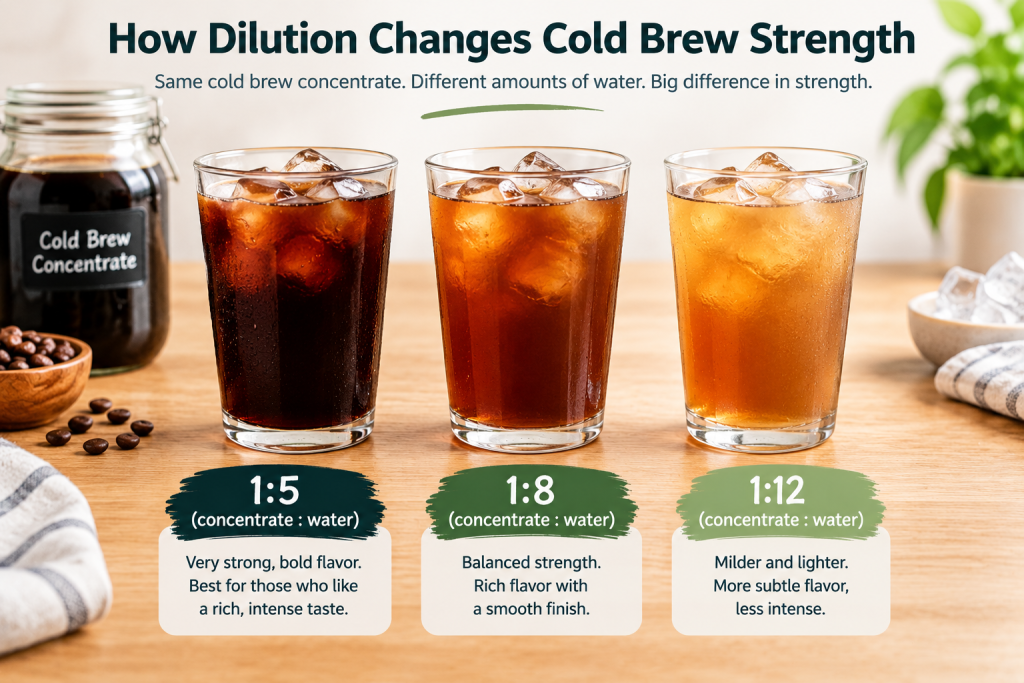
- Dilution. How much water, milk, or ice you add decides the final strength.
- Temperature. Steeping on the counter extracts a little faster than in the fridge.
How to Make Cold Brew Stronger or Milder
For a stronger cup:
For a milder cup:
Change one thing at a time. Keep notes so you can repeat the batch you like best.
A quick example: if you make a concentrate at 1:5 by weight and dilute it 1:1 with water, the final drink works out to roughly 1:10 coffee to water. That is still stronger than a typical hot cup at 1:15 to 1:17. The numbers are approximate because the grounds soak up some water.
Cold Brew vs. Hot Coffee: Quick Comparison
| Cold brew | Hot brewed coffee | |
|---|---|---|
| Typical brew time | 12–18 hours | A few minutes |
| Typical ratio | Often higher | Often lower |
| Taste | Smooth, mellow, less acidic | Brighter, sometimes more bitter |
| Caffeine per serving | Varies widely | Varies, about 95 mg per 8 oz is a common estimate |
| Strength control | Mostly by ratio and dilution | Mostly by ratio and brew method |
Frequently Asked Questions
Q01. Is cold brew stronger than regular coffee? It can be, if it’s made with a high coffee ratio and not diluted. After dilution, it may be the same or milder. Taste and caffeine are separate measures.
Q02. Does cold brew have more caffeine than hot coffee? Not always. Amounts vary by recipe, serving size, and dilution. Check the label or ask the shop if you need a number.
Q03. Why does cold brew taste smoother? Cold water pulls out fewer of the sharp, bitter compounds that hot water extracts quickly. The long steep leaves a rounder flavor.
Q04. Is cold brew concentrate stronger than cold brew? Yes. Concentrate is made with more coffee per cup of water and is meant to be diluted before drinking.